Grapes reward precision at row level and punish a missed interval at harvest.
Table and wine grapes, where the block is the row, the calendar is phenology, and the spray programme is relentless.
Grapes are among the most intensively managed crops on the continent. A vineyard block is worked by row, sprayed on a programme that runs from budbreak to veraison, and picked in a window measured in days. Powdery mildew, downy mildew and botrytis pressure mean the fungicide calendar rarely goes quiet, and every one of those products carries a withholding period.
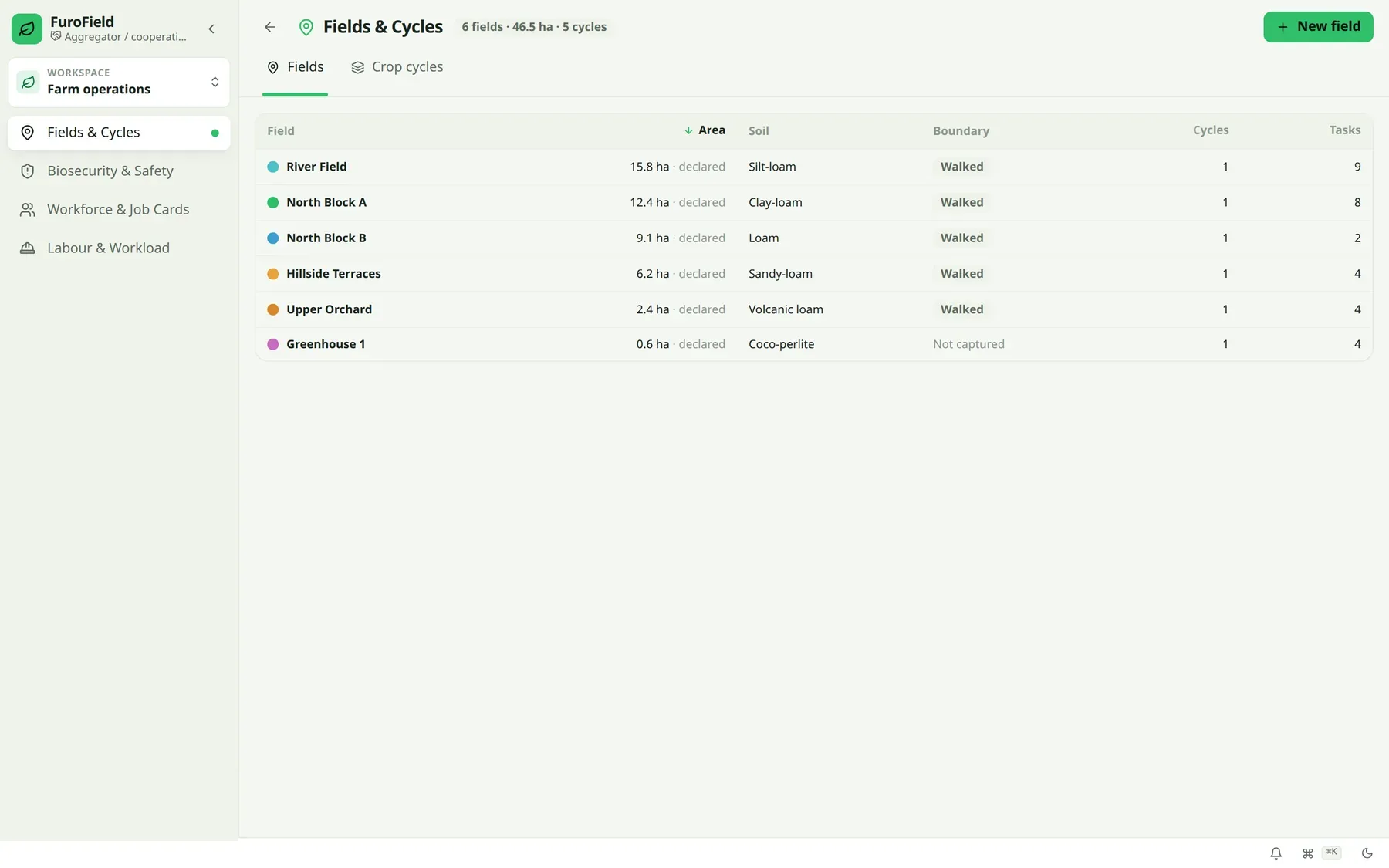
FuroField maps blocks, keeps them across seasons as the perennial assets they are, tracks growth stage through the season, and enforces pre-harvest and re-entry intervals on every application. For table grapes going to an export programme, that spray record is what stands behind the consignment. For wine grapes, the same record is what a winery's own compliance chain depends on.
A dense spray programme makes interval discipline a full-time problem
It is not unusual for a vineyard to receive fifteen or more applications in a season. Each product has its own pre-harvest interval, several are applied close to picking, and the picking decision is made under weather pressure by whoever is available. That is where the failure happens.
- Many products, many intervals, and a picking window that will not wait
- Growth stage and spray timing kept in an agronomist's diary rather than on the block record
- Re-entry after treatment managed informally, in a crop with high labour density in the rows
- No block-level cost record, so an underperforming variety or row section is never isolated
From first record to something you can act on
Map blocks and row sections
Each vineyard block is a mapped field with derived area, separated by variety, trellis and planting year so comparisons hold up.
Track phenology on the cycle
The block's cycle carries its growth stage through the season, which is what drives nutrient timing, scouting prompts and the harvest-window estimate.
Record every application with its interval
Product, rate and target are captured with the pre-harvest and re-entry intervals attached, and the block is held from harvest and from entry until they clear.
Read the whole vineyard before picking
One colour-coded view shows every block as clear, in re-entry hold or in pre-harvest hold, so the picking sequence is set from state rather than argued about.
In detail
Perennial blocks with real geometry
Blocks mapped once, area derived from the polygon, kept across seasons with their cost and production history intact.
Growth-stage tracking
Phenology recorded on the cycle from budbreak through to harvest, driving nutrient plan timing and scouting cadence.
Interval enforcement under a heavy programme
Every application carries its pre-harvest and re-entry interval and holds the block automatically, which is the only workable answer when fifteen products are in play.
Disease scouting with incidence
Powdery mildew, downy mildew, botrytis and mealybug observations logged with severity and incidence percentage against growth stage, and tracked to resolution.
Nutrient and fertigation programmes
Stage-based feed programmes with target rate, unit and method, marked applied as the irrigation block runs.
Cost and margin by block
A spray-intensive crop has a spray-intensive cost base. Booking it per block is what makes variety and site decisions defensible.
Built for these operations
About vineyards
Does FuroField do harvest capture per row and grading into cartons?
The shared harvest and graded-lot register is live against a block and crop year. Vineyard-specific row capture, carton vocabulary, °Brix and GDD packaging remain planned rather than being implied by the generic register.
Can two varieties on the same land be kept apart?
Yes. They are separate blocks with their own geometry, cycles, applications and costs, which is what lets you compare them honestly rather than averaging them.
What if a product's withholding period differs by market?
The interval is recorded against the application, so the figure that applied on the day is the one enforced and the one retained for audit. Where a destination market demands longer, record the longer figure.
Bring your fields online this season
Start free on up to 25 hectares — no card. Scale by the hectare as your operation grows.